Cooking Oil Smoke Points: A Practical Guide
Ever wonder why your oil starts smoking? This guide explains smoke points and helps you choose the right oil for every cooking task.
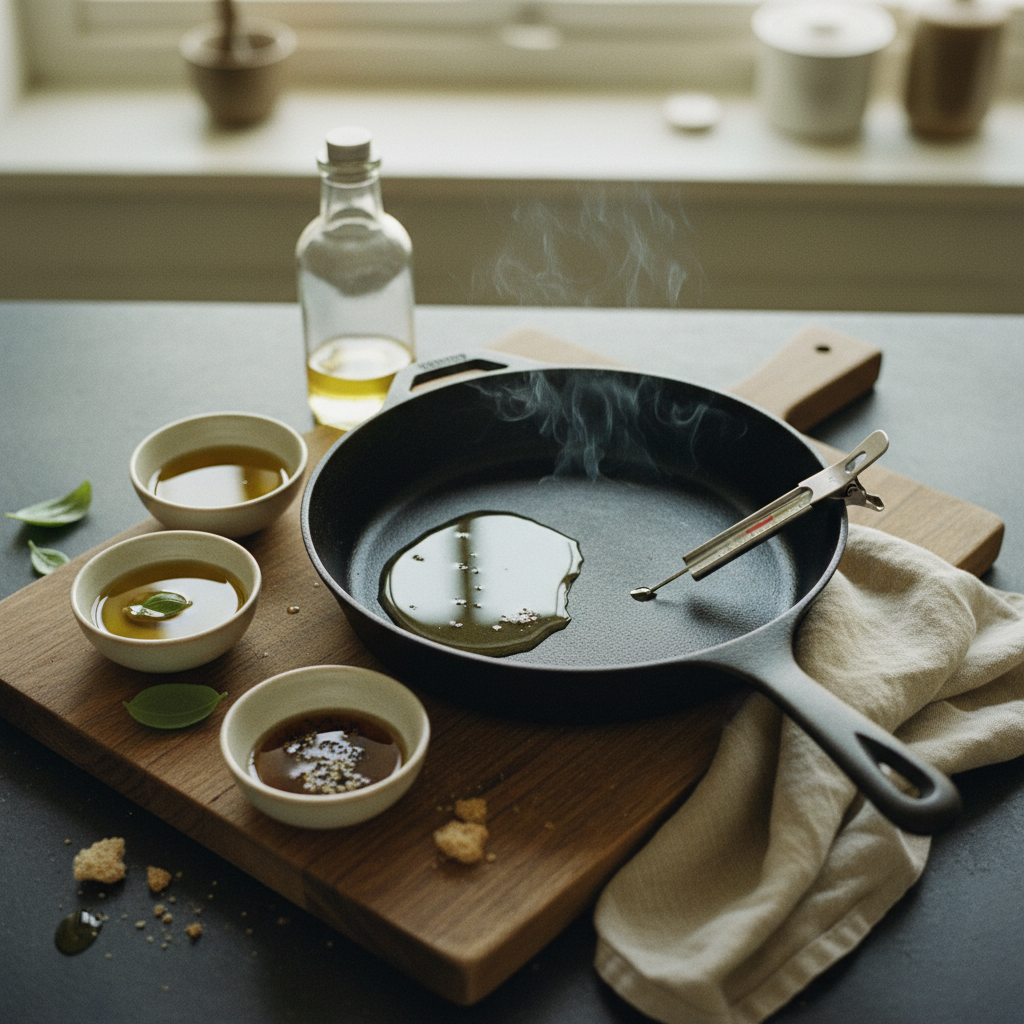
A cooking oil's smoke point is the temperature at which it stops shimmering and starts to break down and smoke. This matters because smoking oil imparts a burnt, bitter flavor and can release harmful compounds. For high-heat cooking like searing, use oils with high smoke points like avocado or canola oil. For low-heat or no-heat uses like salad dressings, use flavorful oils like extra virgin olive oil.
You’re standing over the stove, ready to sear a beautiful piece of fish. You add your oil to the hot pan, and a moment later, a wispy, acrid smoke begins to fill your kitchen. Your smoke alarm might even have a thing or two to say about it. What went wrong?
Chances are, you just exceeded your cooking oil’s smoke point. Understanding this simple concept is one of those little kitchen secrets that makes a huge difference. It’s not just about avoiding a smoky kitchen- it’s about making your food taste better and getting the most out of your ingredients. Let’s demystify smoke points so you can cook with more confidence.
What Is a Smoke Point?
A smoke point is simply the temperature at which a particular fat or oil begins to break down and produce a visible, continuous smoke. Before it smokes, you will often see the oil shimmer and move fluidly in the pan. The smoke point is the stage just after that.
When an oil reaches this temperature, its chemical structure starts to degrades. The triglycerides that make up the fat break apart into glycerol and free fatty acids. The glycerol then breaks down further into a compound called acrolein, which is the source of that sharp, unpleasant smell and the visible smoke. Acrolein is also what gives burnt food that nasty, bitter flavor.
Different oils have different smoke points based on their chemical makeup, purity, and how much they have been refined. An oil with lots of impurities or free fatty acids will have a lower smoke point.
Why Do Smoke Points Matter for Cooking?
Paying attention to smoke points is crucial for two main reasons: flavor and performance.
First, there’s flavor. When an oil smokes, it’s not just an aesthetic issue. The chemical breakdown we talked about imparts a burnt, acrid taste to the oil, and consequently, to whatever you’re cooking in it. You could have a perfectly seared steak, but if the oil was smoking heavily, the surface will carry a distinct bitterness that masks the delicious, savory flavors you worked to create. Protecting the flavor of your oil means protecting the flavor of your food.
Second, there's performance. When an oil breaks down, it loses some of its ability to transfer heat effectively and can become gummy. More importantly, heating oil past its smoke point releases free radicals and other potentially harmful compounds. While your everyday home kitchen isn’t a laboratory, regularly creating a kitchen full of acrid smoke isn’t ideal. Using the right oil for the job helps ensure a cleaner cooking process and a better-tasting final product.
A Guide to Common Cooking Oil Smoke Points
Instead of memorizing exact temperatures, which can vary by brand and batch, it's more practical to group oils by their general heat tolerance. Here is a handy guide:
* **High Smoke Point Oils (450°F / 232°C and above)** * **Best for:** Searing, deep-frying, blackening, stir-frying. * **Examples:** Avocado Oil (refined), Safflower Oil, Grapeseed Oil, Refined Canola Oil, Ghee (Clarified Butter). * These are your go-to oils for getting a hard, fast sear on meats or for any cooking method that requires screaming-hot oil.
* **Medium-High Smoke Point Oils (375-450°F / 190-232°C)** * **Best for:** Sautéing, roasting vegetables, baking, light stir-frying. * **Examples:** Virgin Olive Oil, Coconut Oil, Corn Oil, Classic Butter. * These are versatile workhorse oils that can handle the majority of everyday cooking tasks, from sautéing onions to roasting broccoli in the oven.
* **Medium Smoke Point Oils (325-375°F / 162-190°C)** * **Best for:** Gentle sautéing, baking, sauces. * **Examples:** Extra Virgin Olive Oil (good quality), Sesame Oil. * These oils offer more flavor but can't handle intense heat. A good quality extra virgin olive oil has a higher smoke point than many people think, making it perfectly suitable for a gentle sauté.
* **Low or No-Heat Oils** * **Best for:** Salad dressings, dips, finishing drizzles. * **Examples:** Flaxseed Oil, Walnut Oil, Toasted Sesame Oil, high-quality finishing Extra Virgin Olive Oils. * These oils are prized for their delicate, pronounced flavors and aromas. Heat would destroy these qualities and create off-flavors, so they are best used raw.
Refined vs. Unrefined Oils: What’s the Difference?
Have you ever noticed that 'light' or 'refined' olive oil has a higher smoke point than 'extra virgin' olive oil? The difference comes down to processing.
**Unrefined oils**, like extra virgin olive oil or walnut oil, are generally cold-pressed and filtered. They retain most of their natural flavor, color, and nutrients. However, they also retain natural particles and free fatty acids from the plant they came from. These 'impurities', while contributing to flavor, are less stable and cause the oil to smoke at a lower temperature.
**Refined oils**, on the other hand, go through additional processing like bleaching, filtering, and deodorizing. This process removes almost all of those free fatty acids and impurities. The result is a more neutral-tasting oil with a much higher smoke point. Avocado oil is a great example. Unrefined avocado oil has a lower smoke point and a distinct grassy flavor, while refined avocado oil has one of the highest smoke points and a very neutral taste.
Neither type is inherently 'better'- they just have different jobs. For a flavorful vinaigrette, an unrefined extra virgin olive oil is perfect. For deep-frying chicken, a refined, high-smoke-point oil like canola or peanut oil is the right tool for the job.
Putting It All Together: Which Oil Should I Use?
Let’s make this practical. Here are some common cooking scenarios and the best oil to choose:
* **Searing a Steak:** You need high, direct heat to get a great Maillard reaction crust. **Use a high-smoke-point oil** like refined avocado oil, grapeseed oil, or ghee.
* **Making a Vinaigrette:** You are not using any heat, and you want the oil to contribute flavor. **Use a no-heat, unrefined oil** like extra virgin olive oil, walnut oil, or flaxseed oil.
* **Roasting Vegetables at 400°F (204°C):** This is a medium-high heat application. You need an oil that can handle the temperature without smoking. **A medium-high-smoke-point oil** like regular olive oil, avocado oil, or even coconut oil will work great.
* **Sautéing Garlic and Onions:** This is typically done over medium or medium-low heat to soften the vegetables without browning them too quickly. **A medium-smoke-point oil** like extra virgin olive oil or even butter is perfect here, as it adds great flavor.
Inspired by reporting from Kitchen Tutor.
Frequently asked
- What happens if you cook past an oil's smoke point?
- When an oil is heated past its smoke point, it begins to break down. This creates acrolein, a compound that gives food a bitter, burnt flavor. It also releases free radicals and can fill your kitchen with acrid smoke. Using the right oil for the heat level prevents this, resulting in better-tasting food.
- Is a higher smoke point oil always better?
- Not at all. The best oil depends on the task. High-smoke-point oils are best for high-heat cooking like searing. For applications without heat, like making salad dressing or a finishing drizzle over soup, you should choose an unrefined oil with a lower smoke point, like extra virgin olive oil, because it has much more flavor and aroma.
- Can I reuse my frying oil?
- Yes, you can reuse frying oil a few times. After each use, let it cool completely, then strain it through a coffee filter or fine-mesh sieve to remove any food particles. Store it in a sealed, light-proof container in a cool, dark place. Be aware that the smoke point of the oil will decrease with each use, so it will start smoking at a lower temperature.
- Why does my extra virgin olive oil label say it is good for cooking?
- While EVOO has a lower smoke point than refined oils, a good quality bottle has a smoke point around 375°F (190°C). This is perfectly suitable for most everyday cooking tasks, including sautéing and roasting below that temperature. Lower-quality or older EVOO may have more impurities and smoke sooner. Always use a fresh, reputable brand for cooking.
- Does mixing two different oils change the smoke point?
- Yes. When you mix oils, the resulting smoke point will not be an average of the two. Instead, the mixture's smoke point will be limited by the oil with the lowest smoke point. For example, if you mix high-smoke-point canola oil with flavorful but low-smoke-point butter, the butter will still burn at its usual temperature. It's best to stick with a single, appropriate oil for high-heat cooking.